
By Onur
Serving sizes, ingredient lists and those little percentages explained.
You’re comparing two supplements. One has more capsules, the other has a bigger number on the front, and both seem to offer what you’re looking for. So which one do you choose?
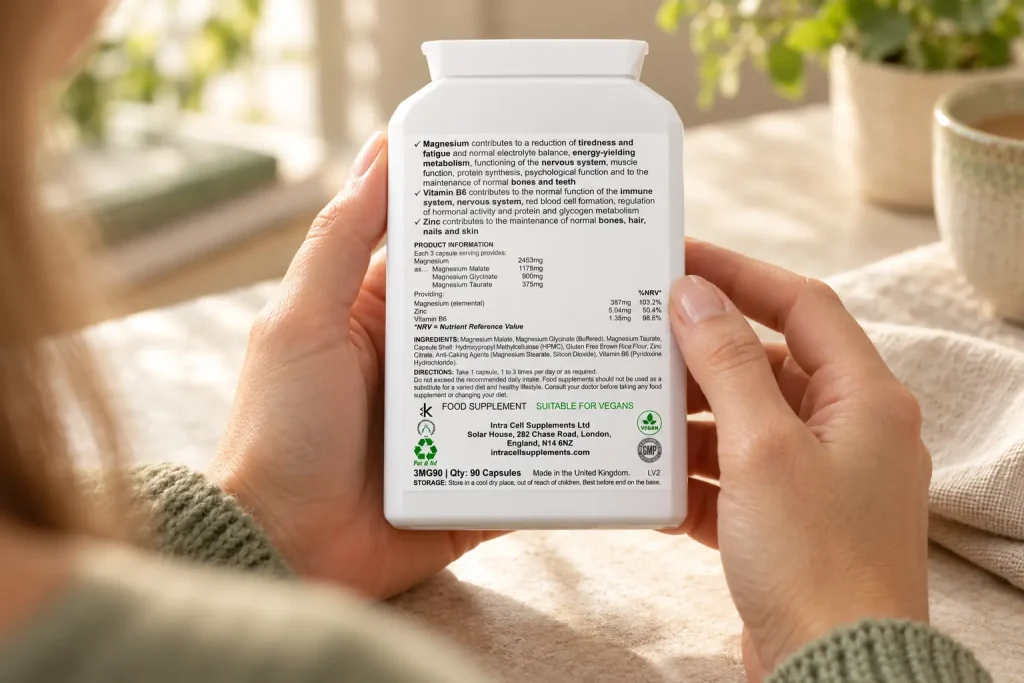
The front of the bottle gives you a starting point. Turn it around and you’ll find the details that make a comparison possible: what’s included, how much you get and how you’re meant to take it.
Here’s what to look for.
Start with the daily serving
A bottle containing 90 capsules might sound like a three-month supply. If the directions say to take three capsules a day, it will last 30 days.
Before comparing ingredient amounts, check the heading above the figures. Does it say “per capsule”, “per two capsules” or “per daily serving”? Those few words change how you read everything underneath. [2]
For example, 500 mg per capsule and 1,000 mg per two capsules provide the same amount per capsule. The larger figure doesn’t necessarily mean a stronger product.
Pay attention to the units
Milligrams and micrograms are easy to confuse, especially when the print is small.
A milligram is written as mg. A microgram may appear as µg or mcg. There are 1,000 micrograms in one milligram, so 1 mg and 1,000 µg are the same quantity.
When comparing the same nutrient across two products, make sure the units match. Comparing different nutrients by their numbers alone tells you very little, because the body needs them in different amounts.
What does %NRV actually mean?
NRV stands for Nutrient Reference Value. It’s a standard reference used on labels for vitamins and minerals. [1]
A figure of 100% means the stated portion provides the full reference amount for that nutrient. It doesn’t mean everyone needs that amount from a supplement, on top of what they already eat.
It also isn’t a quality rating. A product showing 500% NRV isn’t automatically a better choice than one showing 100%. Your needs, your diet and any other supplements you take all matter. The percentage is there to help you understand the amount, rather than give you a target to beat.
Read the ingredients as well as the nutrient table
The nutrient table tells you the amounts provided. The full ingredient list gives you more detail about what’s inside.
You might see the form of a nutrient, such as magnesium citrate, alongside ingredients used to make the capsule or tablet. Powders and gummies may also contain flavourings or sweeteners.
An unfamiliar name isn’t automatically a reason to avoid something. Some ingredients help a tablet hold its shape or keep a powder from clumping. What matters is understanding their purpose and whether they suit you.
If a label leaves something unclear, ask the brand. You shouldn’t have to guess what an ingredient is doing in a product.
Check whether it suits you
A supplement can contain the ingredient you want and still be unsuitable for your diet or circumstances.
Look at allergen information, ingredient sources and any vegetarian or vegan suitability statement. Check the capsule shell as well as what’s inside it.
Read the warnings, too. If you take regular medication, have a medical condition, are pregnant or are breastfeeding, speak to a pharmacist or another appropriate healthcare professional before taking a supplement. [3]
Compare the cost per day
The bottle price only tells part of the story.
Imagine two otherwise comparable products:
- A £12 bottle containing 60 capsules, taken at two a day, lasts 30 days: 40p per day.
- An £18 bottle containing 90 capsules, taken at three a day, also lasts 30 days: 60p per day.
You still need to compare the ingredients and daily amounts, but this gives you a more useful starting point than bottle size alone.
Keep the directions handy
Once you’ve chosen a product, follow its directions and don’t exceed the recommended daily dose. Check the storage instructions and best-before date rather than assuming every supplement can be stored in the same way. [2]
Supplements are intended to add to your diet. They don’t replace a varied, balanced diet and a healthy lifestyle. [3]
Three questions to take shopping
Next time you pick up a bottle, start here:
- How much does the recommended daily serving provide?
- Are the ingredients and warnings suitable for me?
- How long will the bottle last, and what will it cost per day?
You don’t need to recognise every ingredient at a glance. Knowing where to look, and when to ask a question, makes choosing a supplement much easier.