
By Onur
Two bottles can look similar while providing different amounts per capsule or serving. The front gives you a starting point; the information around the back helps you compare what is included, how much you get and whether it suits you.
Start with the serving instructions, then read the amounts, ingredients and warnings together. A bigger number on its own is not a reason to choose a product.
Your quick label checklist
- Serving: Are the amounts per capsule, scoop, measured volume or daily serving?
- Quantity: What amount of the nutrient or ingredient does that portion provide?
- Units: Are you comparing grams, milligrams or micrograms?
- Ingredients: What else is included, and which allergens or dietary restrictions matter?
- Directions and warnings: Is the product suitable for your circumstances, and how should it be used and stored?
Start with the serving, not the bottle size
A bottle containing 90 capsules is not automatically a three-month supply. At one capsule daily it provides 90 days; at three daily it provides 30 days. Those calculations describe duration, not which intake is right for you.
Check the heading above the figures. “Per capsule” and “per three capsules” describe different portions. Also read the directions: a table may use a fixed serving while the directions allow a range. Clear portion information matters when comparing supplements. Supplement-labelling guidance.
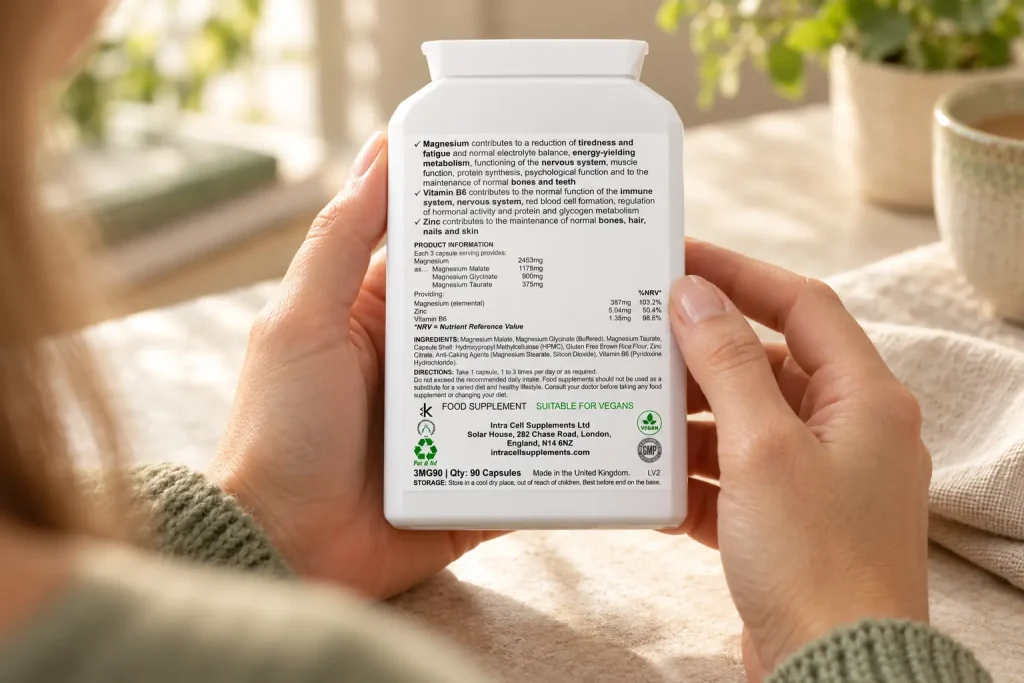
On the product label for Triple Magnesium Ultra, the table gives amounts per three capsules. The directions say to take one capsule, one to three times per day or as required. Do not read the three-capsule table as a separate instruction that everyone should take three daily.
For a powder, check the stated weight rather than assuming all scoops are interchangeable. A serving describes a quantity; the directions tell you how often to use it. Follow those directions and do not exceed the recommended daily intake.
Check the units before comparing amounts
One gram (g) equals 1,000 milligrams (mg). One milligram equals 1,000 micrograms, written as µg or mcg.
For the same ingredient, 0.5g and 500mg are equal amounts. However, comparing different nutrients by their numbers alone tells you little: they have different reference values and uses. Keep the ingredient, unit and serving basis together.
Two real examples: which amount are you reading?
These examples reproduce declarations from our product labels. They explain how to read the figures, rather than recommend an intake.
| Product and label basis | What the label declares | What to distinguish |
|---|---|---|
| Triple Magnesium Ultra: per 3 capsules | Magnesium malate 1,178mg; glycinate 900mg; taurate 375mg; providing 387mg elemental magnesium | Compound weights are not the amount of magnesium itself. |
| Creatine Monohydrate: per 5g serving | Creatine monohydrate 5g; “of which Creatine” 4.4g | The powder serving and declared creatine content are different figures. |
Magnesium compounds include magnesium combined with other substances. The three compound weights above total 2,453mg, but that does not mean 2,453mg of elemental magnesium. The label separately declares 387mg of magnesium itself. Dividing that three-capsule declaration by three gives 129mg per capsule: a calculation from the label, not another serving recommendation. NIH explanation of elemental magnesium.
The Creatine Monohydrate label explicitly distinguishes the 5g monohydrate serving from its 4.4g creatine declaration. These are not two ingredients to add together. Use the product’s own serving and preparation directions; the table is not an instruction to take 4.4g of powder.
For more on magnesium compounds and comparison questions, read Magnesium: Understanding the Different Forms.
What does %NRV mean?
NRV stands for Nutrient Reference Value: a standard adult labelling reference for vitamins and minerals. It helps put an amount into context. UK nutrition-labelling guidance explains the reference terminology.
The magnesium NRV is 375mg. Triple Magnesium Ultra declares 387mg per three capsules, so its percentage is:
387mg ÷ 375mg × 100 = 103.2% NRV, per three capsules.
The same calculation for the derived one-capsule amount is 129mg ÷ 375mg × 100 = 34.4%. Always keep the portion attached to the percentage. Official NRV table, Annex XIII.
%NRV is not a personalised target or a safety limit. A figure above 100% does not automatically mean a product is better, or tell you whether that amount is appropriate for you. Your diet, other supplements and circumstances still matter. Nor does a lower percentage establish that you need to make up the difference with another supplement.
Not every ingredient has an established NRV. There is no established NRV for creatine in that table, so do not calculate a creatine %NRV from its serving weight.
Read the ingredients, allergens and warnings
The nutrient table gives quantities; the ingredient list adds detail about sources, forms, capsule shells, flavourings and other ingredients. An unfamiliar name is not automatically a reason to avoid something. Check its purpose and whether it suits your needs.
Read allergen information separately from vegetarian or vegan statements. Creatine’s product label, for example, identifies a facility handling milk, egg, soy, gluten, nuts and crustacean-derived products. That manufacturing warning is different from saying those are ingredients in the powder.
Check warnings, storage instructions and best-before information. If you take regular prescribed medicines, have a medical condition, are pregnant or breastfeeding, seek advice from an appropriate healthcare professional before using a supplement. Supplements do not replace a varied, balanced diet. Government consumer guidance.
Finally, compare value using the same serving basis, alongside ingredients and suitability. Clear quantities and directions are more useful than the biggest front-label number. For another powder example, read our practical guide to collagen peptides, or explore ingredient lists and labels in the Daily Nutrition collection.